Jason Polkovitz

Graphic Design & Art Direction

  • This morning I read a point/counter-point style article that came my way via Twitter (thanks to @boxofnuts22) talking about the difference between branding and marketing. Here’s the gist of it:

    The first person’s explanation was long and winding, full of MBA-style doublespeak and overly complex sentences. Boiled down he says that branding is company reputation and marketing is everything else – from logo design through advertising, etc.. The second fellow wrote short, simple statements claiming that branding was what makes you different from your competition, logo design, color schemes, etc.; and marketing is how you sell your company’s product or service.

    Now if the description of the styles of explanation didn’t tip you off, second fellow is correct (I’ve no idea where the first guy got his ideas).

    Branding is what helps the audience know who you are without explanation. It exists to make it possible, at a glance, for a potential client to say, ah, this is a Spacely Sprockets product, not a Cogswell Cogs one. It encompasses logos, color schemes, typeface choices, and the style that makes a company recognizable (think Apple’s simplicity and penchant for black, white, and aluminum).

    Marketing is how you use your branding to get the message out there – whether it be advertising, PR, social media, etc..

    Very simply put, branding defines the topic and marketing is the message.

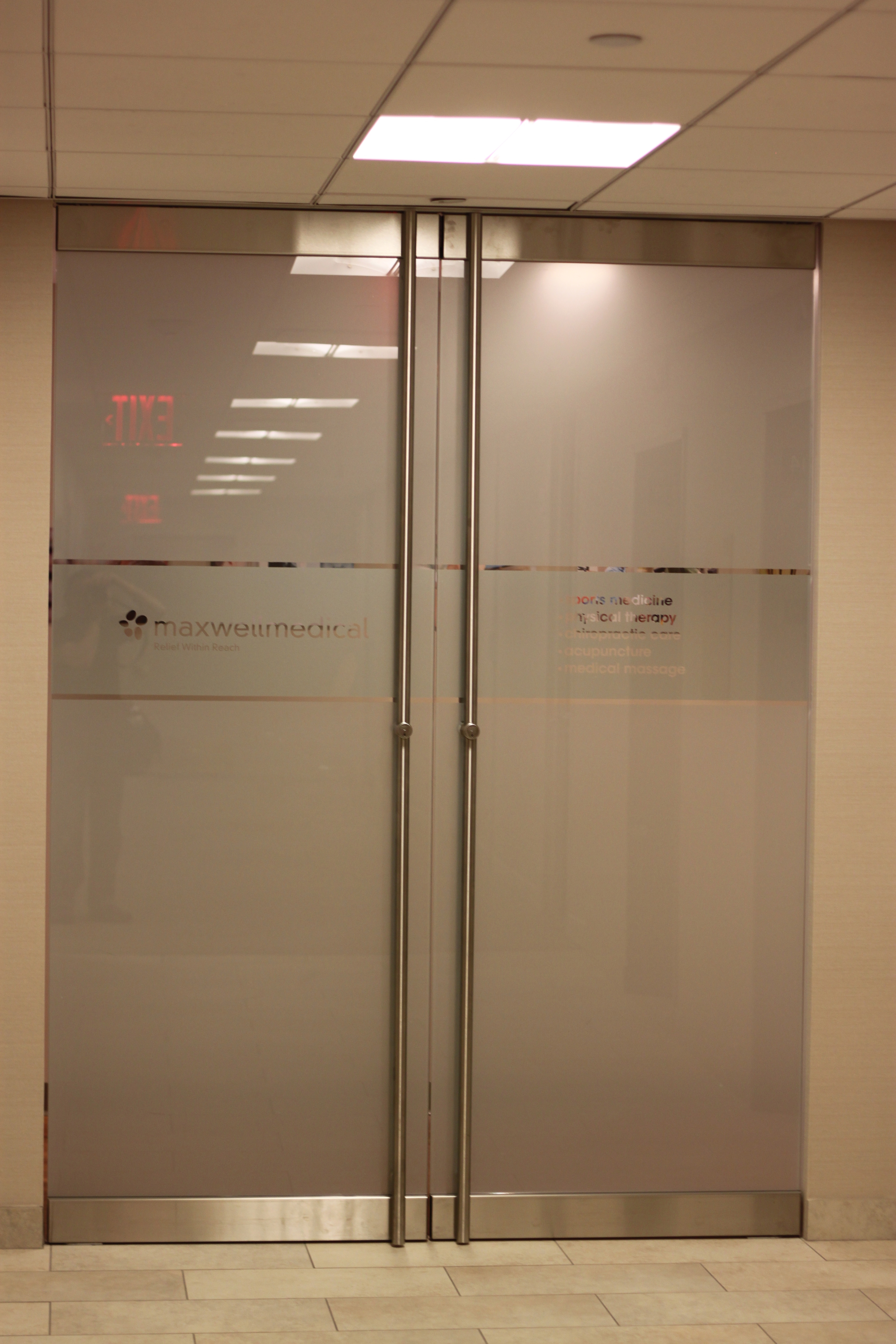
  • MaxWell Medical wanted to give their front doors a classy look while still showing what they do (and make it easier for clients coming off the elevator to tell what door they were supposed to enter). The other requirement was to maintain privacy for the clientele and office staff. Here’s what we came up with.

    IMG_1236 IMG_1238 IMG_1237

    MaxWell Medical Final Door Design

  • TypeExample01

    Context is key.

    You get a lot of people who feel that Helvetica makes everything better and Comic Sans is the typeface of the devil. Here are two designs that follow different philosophies… one based on flat design and Helvetica and one based on a more dimensional design and Comic Sans. I asked my two-year old (who would be the target audience) which he liked better… guess which he chose? Everything has its place. It is vital to consider the tastes of the audience.

    Whether it be typefaces, copywriting, or design style, it is all a question of context.

    (Note: these weren’t done for a client… they are quick and dirty designs for illustrative purposes. Although I do like the bear).

  • That’s what advertising is about. It is about telling a story. A story of boy has a problem, girl has the solution. Boy meets girl and she solves his problem.

    Substitute boy with your target audience and girl with your company and you have an ad.

    You are trying to convince your target audience that your product or service is the very thing they need to solve their problem or meet their need. It is as simple as that. If you don’t engage your target by making them empathize with the story, you aren’t engaging them. A list of your product’s benefits simply isn’t enough. It won’t compel your audience to put themselves in a position that makes them want to come to you. People are convinced to act based on need or perceived need. If you can’t make them feel that conviction, that need to have a problem solved, then you have probably failed to get a customer.

    And without your customers you don’t live happily ever after.

  • IMG_2697Continuing with our foray into the world of label design we encounter “Frankly Good” released by Hot Dog Vineyards through Jack Jones Wines. The idea was to be fun but simple – getting across the idea of a light, white wine that would be perfect for casual dining. A lot of the artwork on the labels done for our clientele were hand drawn, scanned, and  finished in Photoshop.


  • By now I’m sure a lot of you will be aware of Hyundai’s ad promoting one of their low-emission vehicles. There’s this poor soul who, distressed with how life has dealt him a bad hand or something (I’m fuzzy on the details) decides to end it all by committing suicide by carbon monoxide poisoning in his garage. Foiled by the environmentally friendly nature of his Hyundai, he goes off to continue his life. I’m guessing that Innocean (Hyundai’s agency) and the client felt that this would be an edgy promotion, perhaps going viral, culminating with an uptick in profits for the quarter. Maybe they even thought that the message of an environmentally friendly vehicle helping to save a person’s life would be a great message.

    This is one of the most asinine things I’ve ever heard of.

    The first rule of advertising is that an ad is there to help sell a client’s product or service to its intended target audience. Assuming that the intended target audience is human, this ad missed the mark completely. A good agency is able to put themselves in the shoes of the prospective consumer and sell in a compelling and sympathetic manner. Certainly it can be argued that the ad drives home (unintended pun) the point that it is a low-emissions vehicle, but there is nothing funny at all about depression or suicide and all this ad does is make Hyundai look like a bunch of heartless, money grubbing, insensitive bastards (tell us how you really feel, Jason) who wouldn’t know what a human being would think or feel if they ever met one. The apologies issued by both Hyundai and Innocean are quite hollow at this point. That ad should have never made it out of the agency’s creative department, let alone into the wild where actual human beings with feelings would consume it.

    A couple of years ago, Nissan ran an ad with Lance Armstrong (yes, that Lance Armstrong) riding on his bike behind one tailpipe or another while training. The ad culminated in him riding behind a Nissan Leaf – an electric vehicle with no tailpipe at all. We could almost feel the fresh air invigorating our beleaguered lungs. All of us have walked behind a bus or a car with an emissions problem and inhaled a noxious, choking cloud of carbon monoxide. It is unpleasant. This ad reminded us of that and made us sympathize with the narrator – feeling great relief that the time is coming where we don’t ever have to deal with that again. It appealed to our common experience. This was a good ad. It was positive and made us think kindly toward Nissan and their forward thinking, sympathetic motives. Whether or not that was their motivation is irrelevant, it was the message of the advertisement and it is one that appeals to the target audience on an emotional level.

    On a personal/professional note:  there is a common feeling out there that advertising agencies are only out there for the money and we prey on poor consumers by convincing them to buy things they don’t really need and might not be able to afford. Innocean seems to be out there to prove this to be true, and it doesn’t help the rest of us who (while making money for ourselves is, of course, why we have turned our talents to a field where they can feed our families) feel like what we do serves the purpose of helping others build and maintain their businesses – in the end adding to the well-being of their companies, employees, and the economy as a whole. The best and most creative of us can use our common experience and emotional intelligence as tools to accomplish this goal. Those who do not make the rest of us look like ogres.

    And for that I’d like to say stop. Please, just stop. We are all human and it is in our best interests, both as people and as advertisers, to remember that.
  • Image

    Let me start by saying I like Helvetica. A lot. It is a wonderful typeface with a plethora of uses, but (and here is where I’m going to get in trouble with typophiles everywhere) it is not the be-all-and-end-all of typefaces.

    It is not, as some would have you believe these days, the bacon of the typographic world (that’s another kettle of fish – but this is a design blog, not a food one).

    Now while you are off sharpening your pitchforks, let me explain:

    Helvetica does not make every design better. It is a very clean, easy to read typeface. Of constant weight and line, it is pleasant to look at and legible at a distance. To me, it is the white meat chicken of typefaces. It can be used in many different situations to great effect. A very utilitarian font, but there are others of equal dignity and perhaps of greater impact. White meat chicken is universally liked for a reason: it goes with so very many things and is completely inoffensive and sometimes (when prepared well) quite delicious.

    So when choosing your typographic weapons, choose carefully. Helvetica isn’t for everything and, considering its ubiquity these days, should be used intelligently. Embrace your Copperplates and Garamonds, rejoice in your Avant Gardes and Neutrafaces. Remember that, as a designer, it is your duty to help your client stand out in the crowd. If we all wear the same clothing, we don’t shout out our uniqueness. And that uniqueness is what separates us and calls attention to what we have to offer.

  • Outside of the obvious reasons a company should consider a branding plan – strong identity, a clear message, the possibility of the holy grail of brand loyalty – there is the added bonus of speed.

    With a well-crafted branding scheme in place, the designer and client hit the ground running on every project. There doesn’t have to be endless iterations of every single piece, with every detail scrutinized  by everyone and everyone’s aesthetic two cents being offered ad infinitum – this can lead to a slow roll out of the end product or, worse yet, the project grinding to a halt.

    With a strong brand, the ad/direct mail/tv spot/email blast/whatever can be put together (relatively) quickly, with the marketing manager and designer on the same wavelength since the broad strokes of the design were established ahead of time. Now this doesn’t mean everyone can’t have some fun (certainly copy and image won’t be the same from project to project and every product/service/target should be considered carefully) and the guidelines don’t have to be considered a hard-and-fast template; but if the typefaces, color palate, general logo placement, and tagline are concrete, a good design can be created with little fuss and virtually no conflict between agency and client.

    A good brand should inform your design and will ultimately streamline the creation of a strong campaign.

  • Last night I saw this on the Google+ Graphic Design community I belong to:

    “What do you consider to be good #graphicdesign elements?”

    Sigh.

    Here’s why this is a silly question. A good graphic design element is one that fulfills its intended purpose. Design doesn’t exist in a vacuum – and certainly design elements don’t. Its like asking me what kind of chair I like when I don’t know if it should be an office chair, a dining room chair, or a living room chair. It is vague to the point of nonsensicality.

    Typography is a good design element. Photography is a good design element. Illustration is a good design element. Anything is a good design element, as long as it serves its purpose. Does the design need type? OK, great. Will a photograph cement the message in the target audience’s brain? Fabulous, let’s use one.

    The primary difference between art and design is that design exists for a reason which stands apart from its creator. Ray and Charles Eames, and Philippe Starck create(d) things that, when standing alone could be (and probably SHOULD be) considered art. Certainly when you see them at a museum or gallery they stand as lovely or thought-provoking aesthetic pieces. On the other hand, they were created to serve a purpose first. No one would suggest using an Eames lounge chair as a dining room chair – it wouldn’t serve that purpose well. And when I encountered a Starck designed toilet in someone’s house, I enjoyed the design of the thing, but what I enjoyed more at the time was that it did its job.

    In design form should never trump function. If the later isn’t successful, the former is just about ego.